
Best Telescopic Belt Conveyor Manufacturers for Truck Loading Docks
)
We’ve installed RKLoad units in courier hubs handling 6,000+ parcels an hour, so the tradeoffs below come from commissioning notes, not marketing.
What Telescopic Conveyors Solve?
A telescopic belt conveyor is a powered boom that telescopes — usually two or three nested sections — out of the dock and into the trailer body. The operator rides it forward as the wall builds. Reach is the headline number. Most units extend 8 to 24 meters, enough to serve the deep end of an intermodal container without anyone walking product in by hand.
Here’s the part the reach figure hides. The conveyor is only useful if it holds belt speed and tracking while cantilevered at full extension. Cheap booms sag, the belt drifts, and you spend Tuesday morning re-tracking instead of loading.
| Spec | Why it matters | Realkey RKLoad |
|---|---|---|
| Max reach | Serves trailer nose without manual walk-in | Up to 21 m |
| Belt width | Parcel mix, polybag vs. carton | 600–1000 mm |
| Throughput | Peak-hour parcels per operator | 1,800–2,500 cph |
| Boom sections | More sections = deeper, heavier | 2–3 telescoping |
How to Compare Telescopic Conveyor Manufacturers?
Direct answer: rank telescopic conveyor manufacturers on full-extension stability, belt tracking under load, control ergonomics, and local service response — in that order. Reach and price are easy to compare and tell you the least about whether the unit survives three shifts a day for five years.
Run the comparison on four things.
Stability at full reach. Ask for the deflection figure at maximum extension with rated load on the head. If a vendor won’t give it, that’s your answer. A boom that droops 80mm at the tip will chew belts and frustrate operators who have to fight the incline.
Belt tracking and crowned rollers. Telescoping sections each introduce an alignment seam. The makers who get this right use self-tracking idlers and crowned drive pulleys so the belt re-centers itself. The ones who don’t ship you a tensioning wrench and a prayer.
Operator controls. The best units put a wired or wireless pendant at the head so the loader drives the boom forward without walking back to the dock. Variable speed, e-stop within reach, and a clear belt-direction toggle. Sounds basic. Half the field still mounts controls at the base.
Service footprint. A boom down during peak is lost trailers. Confirm spare-belt lead time and whether the maker has techs in your region or ships parts from another continent.
Realkey RKLoad and the Field
Among telescopic conveyor manufacturers serving parcel and 3PL docks, the names that come up in RFQs are Caljan, Joloda Hydraroll, Stewart & Stevenson, and Realkey. Each fits a different buyer.
Caljan owns the express-parcel pedigree — deep installed base in postal sorting centers, premium price. Joloda leans toward heavy palletized freight and automated trailer loading systems, which is a different animal from loose parcel handling. Stewart & Stevenson and regional fabricators compete on price and short hauls but thin out on automation and controls.
We built the custom buying guides reference around the RKLoad TBC because the gap we kept hearing about was mid-market: operators who needed Caljan-grade stability without the postal-monopoly price tag. Realkey’s 19 years in sortation and 200+ global installations went into the boom geometry — three telescoping sections, self-tracking belt, head-mounted pendant standard. Throughput lands at 1,800 to 2,500 cartons per hour per operator depending on parcel mix.
A Southeast Asian 3PL running RKLoad units across eight bays cut trailer unload time from 52 minutes to 31 on standard 40-foot containers. The boom’s reach (they spec’d the 18m variant) meant zero manual walk-in for the back third of the trailer, which is where the labor and the injuries used to pile up.
Realkey customers in apparel fulfillment report a different win: the variable-speed head lets loaders slow the belt for hanging-garment cartons that tumble at full speed. Small thing. Saves damage claims.
Matching the Conveyor to Your Dock
Reach should match your deepest trailer plus a working margin, not your average. If you load 53-foot dry vans, a 15m boom leaves the nose short and your crew walking the gap. Spec to the worst case.
Belt width tracks your parcel profile. Polybag-heavy e-commerce mixes ride fine on 600mm. Mixed carton and tote operations want 800mm or wider so nothing rides the edge and jams the seam between telescoping sections.
Then there’s the dock itself.
- Fixed-height docks: standard boom, mounts to the dock face.
- Variable trailer heights: spec a unit with vertical head adjustment so the belt meets the trailer floor, not the ceiling.
- Multi-bay peak operations: budget for one spare belt on the shelf per four units. Belts are the consumable, and a same-day swap beats a three-week air freight.
According to the Material Handling Institute, automated loading and unloading is among the fastest-growing categories in warehouse capital spend through 2027 — driven mostly by dock labor scarcity, which is exactly the problem a telescopic boom attacks.
One caveat worth stating plainly: if your trailer volume is under roughly 3 trailers a day per dock, a telescopic conveyor may not pay back against a good extendable gravity setup. The math favors automation at high, sustained throughput. Below that, you’re buying capacity you won’t use.
Integration With Your Sortation Line
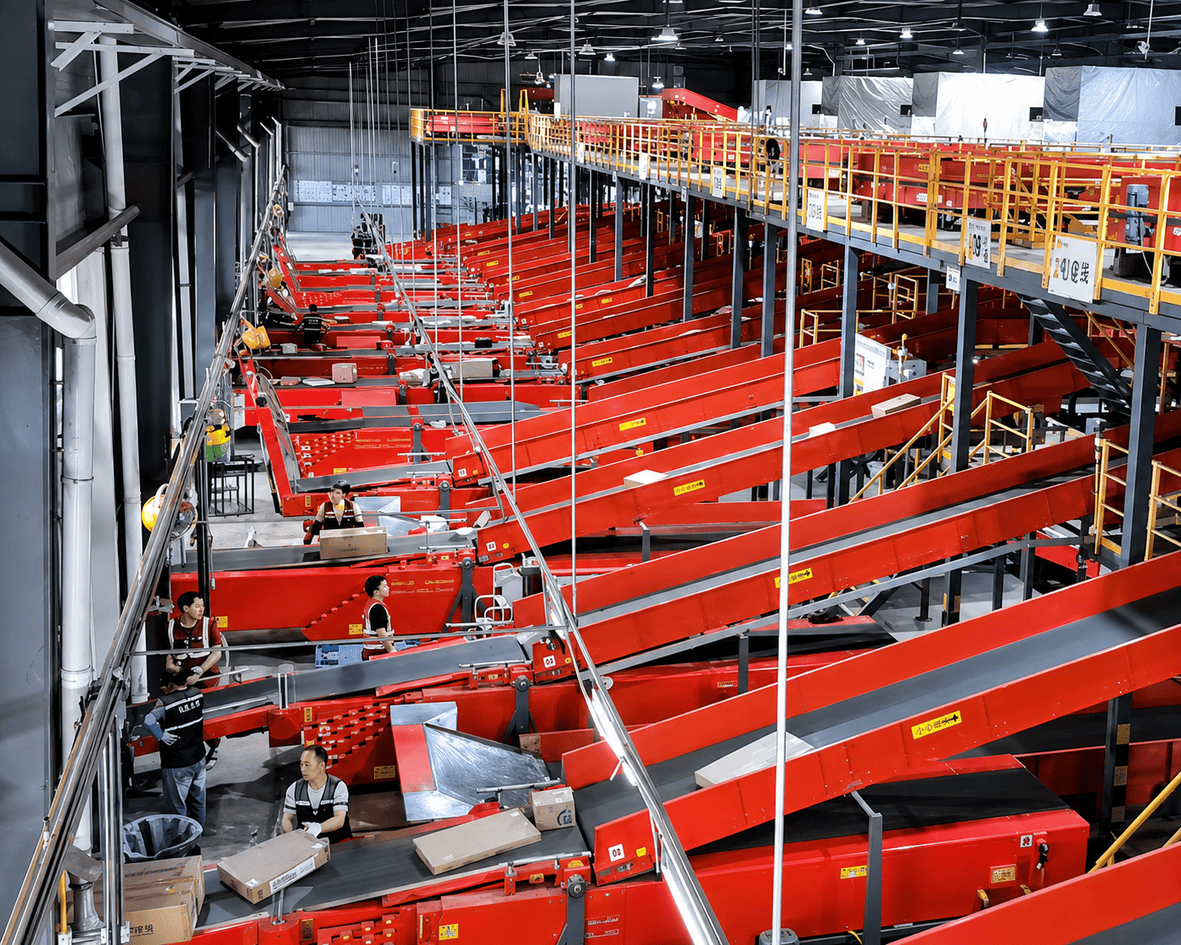
The boom is the last meter of a longer system. Where the parcel arrives at the dock head — and how fast — depends on what feeds it. A telescopic loader fed by a stalling merge line just relocates the bottleneck to the trailer.
This is why we push buyers to spec the loading conveyor and the sortation feed together. If you’re building or upgrading the upstream line, our guide to choosing a belt conveyor manufacturer for parcel sorting walks through matching feed rate to dock capacity so the boom never starves or floods. Realkey’s 30+ R&D staff and 20,000 sqm production floor let us build both halves to one set of drawings — controls that talk to each other, belt speeds that match, one service contact instead of three.
FAQ
What is a telescopic belt conveyor?
A telescopic belt conveyor is a powered boom that extends in nested sections from a loading dock directly into a trailer or container, so operators load and unload parcels at the working face instead of carrying them in by hand.
How far do telescopic conveyors reach?
Most units extend between 8 and 24 meters. Spec the reach to your deepest trailer — a 53-foot dry van needs roughly 18 to 21 meters to serve the nose without manual walk-in.
Are telescopic conveyors worth it for small docks?
Below about 3 trailers per dock per day, an extendable gravity conveyor often pays back faster. Telescopic booms earn their cost at high, sustained throughput where dock labor is the constraint.
Send Realkey your trailer mix, peak parcels-per-hour, and dock dimensions, and we’ll spec an RKLoad TBC boom against your actual worst case — not an average — and put a deflection figure and a service lead time in writing. That’s the part most quotes leave out.